
McDonald County Release Date Types
A projected release date is an official future date associated with a sentence or a parole decision. An actual release date records an event that has taken place. Missouri also uses a parole hearing date, presumptive parole date, conditional release date, minimum release date, maximum release date, and supervision expiration date. Each answers a different question. The Missouri Department of Corrections glossary treats a minimum release date as the conditional release date, while the historical Sunshine file separately reports minimum and maximum release dates.
Custody matters just as much as the label. A person awaiting trial at the McDonald County Detention Center may not have a computable release date at all. Bond, dismissal, a plea, trial, warrant resolution, or a detainer can change the result. A detainer is a request by another authority to hold or receive the person. For a county sentence, use the judgment, jail-credit information, and sheriff record. State-prison date fields do not apply if MODOC never received the person.
Find a McDonald County Release Date
Start by deciding whether the person is in the county jail, a Missouri prison, or community supervision. The McDonald County JailTracker roster is a current-listing check only. A missing name does not prove release. The sheriff's detention center page supplies the jail route, while the court record explains the order or sentence behind custody.
Use this sequence to locate the official record without estimating a date:
- Match the person with a full name plus a booking number, court cause number, birth date where public, or DOC number. A name alone can produce a false match.
- For a pretrial or county-sentenced person, check the court order through the McDonald County Circuit Clerk, then ask the jail for the custody-ending entry.
- For a state prisoner or active supervisee, complete the CAPTCHA at the MODOC Offender Web Search. Open the matching record and identify whether the assignment is an institution or a field office.
- Read the field name exactly. Do not substitute a hearing date, supervision term, or maximum expiration for a projected release date.
- If the person is fully discharged and absent from the active search, check the MODOC Sunshine historical file, then request clarification from DOC when a field remains unclear.
The active MODOC search expressly excludes discharged offenders. That limit is why the county court, sheriff file, and historical state file remain important after a release. A complete search path is available in the McDonald County released-inmate search, including custody-transfer checks.
Note: Record the agency, date label, and observation date so a later change can be compared with the same official field.
McDonald County DOC Date Fields
The MODOC active search covers people in prison and people under active field supervision, including parole, conditional release, and probation. Probation is court-ordered supervision and may occur without a prison term. A field-office assignment therefore does not by itself prove that a person left prison. Confirm the supervision type, sentence, conviction county, cause number, date field, office, and any Board decision.
The official MODOC active-search landing page shows the CAPTCHA and warns that discharged offenders are excluded.
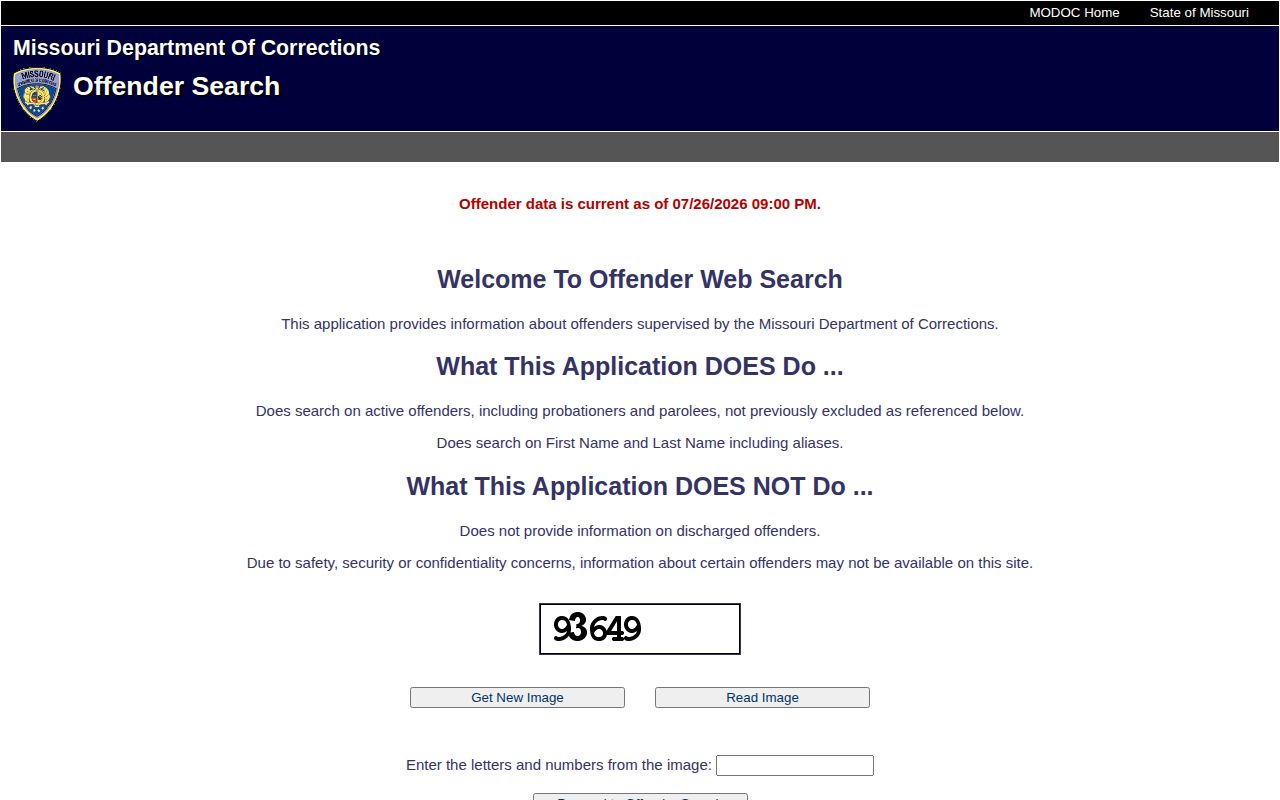
That scope statement prevents an empty active result from being mistaken for proof of release or final discharge.
For older or completed records, the MODOC Sunshine offender data page explains the nightly historical file and its date fields.
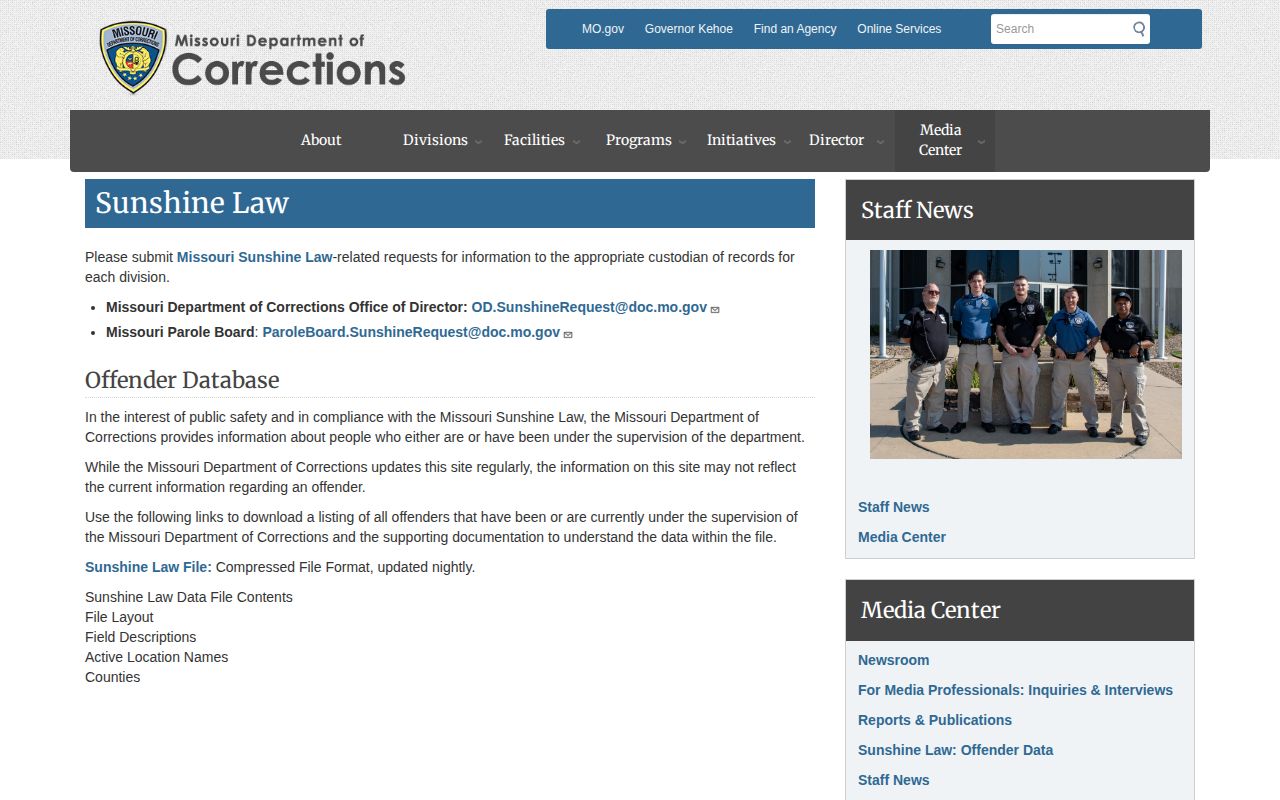
The historical file can connect a DOC number, cause number, sentence county, completed flag, and minimum or maximum date, but it does not narrate the physical release event.
| Official term | What it means | What it does not prove |
|---|---|---|
| Parole hearing date | When the Board considers the case | That parole was granted or release followed |
| Presumptive parole date | A future Board-set date subject to conditions | Actual departure on that date |
| Minimum or conditional release date | The statutory end of the prison portion for an eligible sentence | That no extension, hold, or later action applies |
| Maximum release date | Expiration after the full term | An earlier parole or conditional-release event |
| Actual release date | The custody event that occurred | Completion of all later supervision |
Missouri Release Date Rules
Missouri law explains why two official dates may appear, but it does not support a public calculation for one person. Under RSMo § 558.011.4, an eligible term-of-years felony sentence can consist of a prison portion followed by conditional release. For a term of nine years or less, the final one-third is the conditional-release term. For more than nine through fifteen years, the final three years form that term. For a term over fifteen years, it is the final five years. Dangerous felonies and other listed exclusions can change that framework.
The same law allows the Board to extend a conditional-release date after the required violation petition and hearing process, potentially through the full sentence. Consecutive sentences, credit corrections, prior commitments, program requirements, and Board action also affect the official computation. Only MODOC can apply the complete record to the governing law.
Administrative good time is separate. RSMo § 558.041 authorizes credit on a superintendent's recommendation under DOC policy for orderly conduct and program use. Credit may be lost or rescinded after violations. The statute gives no universal number of days per month, so no fixed rate should be applied to a McDonald County case.
Note: McDonald County publishes no local jail good-time schedule or weekend-adjustment policy, so state-prison formulas must not be imported into a county sentence.
McDonald County Minimum Date Limits
The widely cited 85 percent rule is not a rule for every Missouri prisoner. Under RSMo § 558.019, a person committed to DOC for a statutorily defined dangerous felony generally must serve at least 85 percent before parole, conditional release, or another early release, with a distinct age-based provision in the statute. The same section contains other minimums for specified non-dangerous offenses when qualifying prior commitments exist.
Those percentages establish eligibility thresholds. They do not promise release. A presumptive date may depend on an approved plan or required program. Good-time credit cannot be assumed to override a mandatory minimum, and the offense label in a booking record may not establish the final conviction. Use the judgment and MODOC calculation.
- Eligible
- The person has reached a legal point at which release may be considered.
- Presumptive
- A planned date that remains subject to stated conditions and change.
- Conditional release
- The supervised final part of an eligible Missouri prison sentence.
- Discharge
- The end of custody or supervision, as identified by the responsible agency.
Why McDonald County Dates Change
A future date is a snapshot of the official calculation at that time. The cause of a change should be confirmed with the office that made it. When two sources disagree, identify whether each date is a hearing, eligibility point, scheduled release, sentence expiration, supervision end, or actual custody event.
| Change factor | Possible effect | Best confirmation |
|---|---|---|
| Good-time award, loss, or rescission | Moves the department's computed date | MODOC sentence record |
| Consecutive sentences or credit correction | Changes the time applied to the total term | Judgment plus MODOC calculation |
| Program prerequisite or institutional violation | Delays a presumptive or conditional event | MODOC or Board record |
| Board extension, grant, denial, or revocation | Replaces or removes a prior expected date | Missouri Parole Board decision |
| Detainer, warrant, or receiving authority | Ends one custody but starts or continues another | Sheriff transfer entry and receiving agency |
| Court amendment | Changes the sentence or legal authority | McDonald County court docket and order |
An absconder has not discharged merely because the person is outside an institution. Absconding means the person remains under supervision but has failed location or reporting duties. A warrant or revocation can return the person to custody and eliminate an earlier conditional-release date.
Resolve McDonald County Date Conflicts
Different records can be accurate while showing different dates. Arrest time, booking time, a judge's order, bond posting, jail processing, transfer, and physical departure are separate events. A Friday court order may precede a release entry recorded after midnight. State records add more milestones, including sentence date, parole hearing, presumptive parole, conditional release, and supervision expiration. When reporting a result, name both the date and the event instead of presenting one unlabeled value.
Identity must also be reconciled across systems. JailTracker may use a middle initial, Case.net may show a full legal name, and MODOC may list an alias. Match at least one additional lawful identifier, such as a booking number, cause number, DOC number, or birth date where displayed. The Sunshine file is charge-based, so one person can occupy several rows. Its cause number and sentence county help connect a state sentence back to the McDonald County case.
Negative search results are weak evidence. A person can be absent because the county roster removed a closed booking, MODOC excluded a final discharge, a court matter became closed, or the name format differed. State the system and observation date, then continue to the next official source. For a county custody question, the sheriff's release or transfer entry is strongest. For state prison, use the DOC record. A receiving-agency record can show that an apparent release was actually a transfer.
McDonald County Release Date Proof
The strongest evidence comes from the custodian that ended custody. For a Pineville jail release, ask the McDonald County Sheriff's Office for the inmate-file entry showing the admission date, actual custody-ending date and time, release or transfer disposition, authority, and receiving agency when present. The Missouri sheriff retention schedule identifies those details in the inmate-file series. The court order explains legal authority, but the jail timestamp is stronger for physical departure.
A request can be sent to the jail with the full name, approximate booking period, booking number if known, and a clear list of existing fields. The county's fillable public-record request form is a backup route, but its election-related boilerplate and price table should not be treated as a jail-record fee schedule. Ask the sheriff for an estimate and electronic delivery.
For state custody, use the active MODOC record near the expected event and the historical file after discharge. A notification is useful for timing, but it is not the final record. The current Missouri process for a specific custody-change alert is described on the McDonald County VINELink check page. Confirm the alert against DOC or the jail file because a transfer can appear as release from one agency.
Note: Never turn sentence length, a bond amount, or a roster disappearance into an individual prediction; use the official labeled date and later custody record.